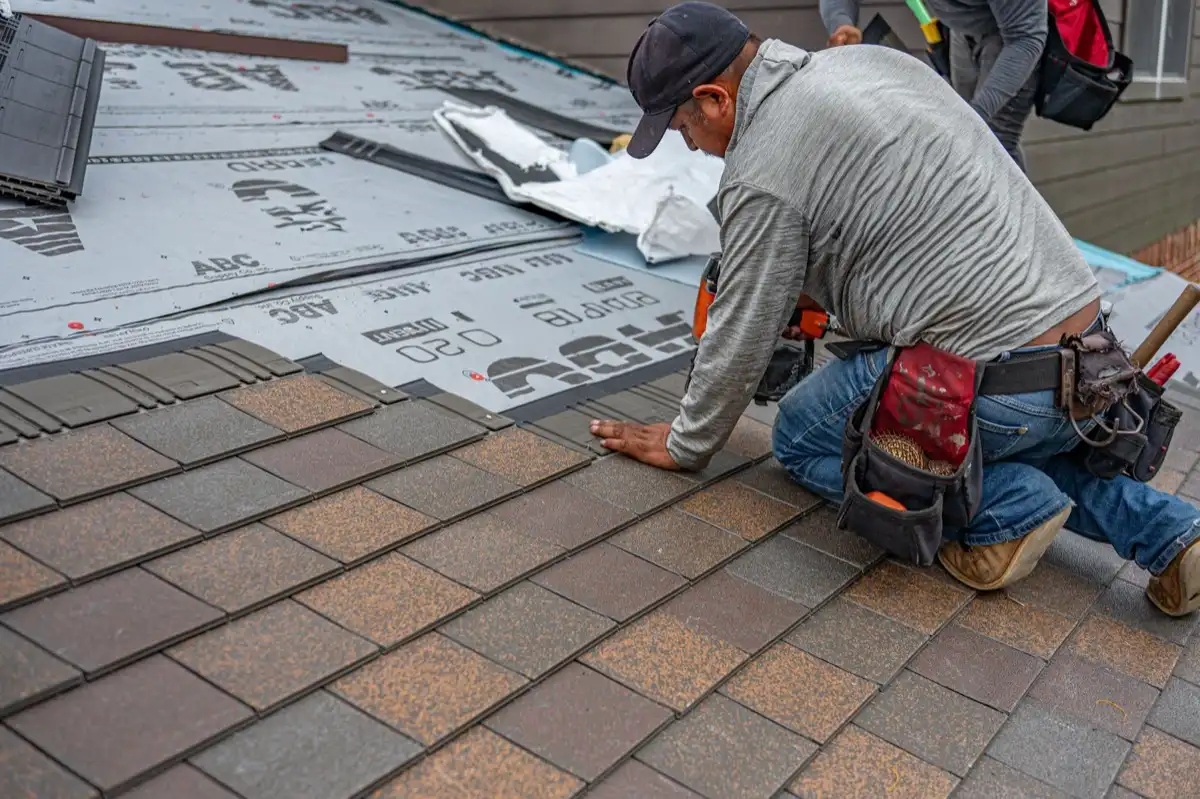
The same vent, on the same forty feet of ridge, is two completely different prices. During a tear-off it is close to a rounding error. On a finished roof it is a project with its own mobilization, its own risk and its own minimum charge.
Nearly every published ridge vent price answers the second question while sounding like it answered the first. A ridge vent is cheap as a component and expensive as an access problem, and everything below follows from that.
On a re-roof the expensive parts are already paid for by something else. Cap shingles off, deck bare, saw on the roof, crew on the clock either way. What remains is a strip of vent, a cut that takes minutes, and a course of cap over the top.
On a retrofit none of that holds. Somebody comes out for this one job, strips a ridge that was watertight that morning, cuts into a deck with framing directly beneath it, and lays new cap onto shingles a decade into their weathering.
On a tear-off it is nearly free
Set against the cost of a re-roof, a ridge vent is a low single-digit percentage of the total — one of the smallest genuinely useful upgrades on that invoice, sitting next to line items that cost many times more and change less. So if a re-roof is anywhere on the horizon, wait and do it then. Paying twice for access to the same ridge is the same error as paying twice for access to the same roof, and roof replacement cost has the wider version of that argument.
Two corollaries, both worth being awkward about. Get it itemized — a vent that costs almost nothing to add is also almost free to leave out and describe as included, so ask for linear feet of ridge vent on the contract, as a number. And have the old exhaust taken out at the same time: on a tear-off, box vents disappear at close to no marginal cost. Later, each one is its own patch.
The retrofit is a different job under the same name
Three things carry the cost on a finished roof, and only one of them is the vent.
Stripping and re-capping the ridge. The existing cap comes off the full run and mostly goes in the skip. Cap shingles are bent over an edge and nailed; they do not come off intact after a few years of ultraviolet.
The cut. The slot is narrow — one each side of the ridge board, or a single continuous slot on a truss roof — and Roofing Contractor is blunt that wider is not better, because the vent's own openings fix the airflow, not the hole. The product side of that is in the vent survey. The cost consequence is separate: saw depth is set to the thickness of the sheathing, and a blade run deep bites the ridge board on a stick-framed roof or a truss top chord on an engineered one. That stops being ventilation work and becomes structural repair, in the least convenient place on the house.
Mobilization and the minimum. A short ridge is not really priced by the foot at all. It is priced by the minimum service charge, the way a small flashing repair is, so on a hip roof with fifteen feet of ridge the per-foot arithmetic is fiction. You are buying a visit.
What the vent itself costs, and what the premium buys
The vent is the smallest number on the page, which makes upgrading it a poor place to spend.
| Vent | What it is | Cost consequence |
|---|---|---|
| Rolled matting | Fibrous roll, no rigid shell | Cheapest, fastest to lay, lowest profile |
| Rigid shingle-over | Molded plastic, external baffle | The default; nails hide under the cap |
| Rigid, snow-rated | Same shell plus a weather filter | Costs more, vents the same |
| Aluminum strip | Exposed metal, no cap over it | No cap shingles; fasteners stay exposed |
The instructive pair is the middle two. GAF rates both Cobra Rigid Vent 3 and Cobra Snow Country Advanced at 18 net free square inches for every foot of ridge. Identical. The premium buys a snow filter, and it buys no additional ventilation at all — so a quote justifying a higher vent line on the grounds that it moves more air is wrong on its own manufacturer's data sheet.
The external baffle is a different question and worth the small difference: the raised lip that turns wind crossing the ridge into suction and keeps driven rain and powder snow out of the slot. A vent without one is cheaper and depends on the weather being polite.
Aluminum is the real saving with a real trade-off: no cap shingles to buy or fit, but every fastener sits on the exposed face for the life of the vent, and the ridge reads as a metal strip rather than a slightly fat peak.
The four things that move a retrofit number
Ridge length. The input that scales linearly, and the one people assume tops out. It does not — a ridge gets vented end to end or the difference is lost, so a long ridge is a long bill. What tops out is the benefit, which intake sets: exhaust the eaves cannot feed buys nothing, and the sums are in the attic ventilation calculator.
Pitch and access. Every hour of this job is at the peak. Past roughly 7:12 the crew is on jacks and tied off for all of it rather than part of it, so the steep-roof premium applies to the whole job. Two stories, no truck access, an unwalkable covering — the same drivers as any roof leak repair, concentrated at the worst point on the roof.
Cap shingle availability. New cap sits against a field that has weathered for years, and a discontinued color is ordinary on a roof over ten. Cap is sometimes cut from field shingles to get the color, which most manufacturers advise against because bending a laminate cracks the mat. So: accept a visibly new ridge, or find that the cap has quietly become an argument for doing the whole roof.
Whether the existing exhaust has to come out. Which is the next section, because it is not a footnote.
The line item that decides whether you bought anything
Here is where a fair price turns into a wasted one.
A ridge vent on a house that keeps its gable louvers is a job half done. The ridge draws from wherever resistance is lowest, a gable is a large opening a few feet below it, and the loop collapses into the top of the attic while the far bays sit still — the short circuit, in full. GAF's ventilation guidance says gable vents should be closed where continuous soffit and ridge venting is used, and its Cobra installation instructions say the ridge vent should be the only exhaust for that attic space.
So an honest ridge vent quote frequently includes closing something off, and that work is not free. Louvers get blocked from inside. Box vents get pulled, the deck patched and shingles woven back in — contractor guides budget roughly half an hour to an hour per vent for the removal alone, before the patch. On a short ridge with three box vents on the field, taking them out can rival the vent line itself.
So a quote carrying a ridge vent and nothing else is either cheap or incomplete, and the paper will not say which. Ask directly: what is the existing exhaust, and what happens to it?
Why the published ranges cannot quote your ridge
They are not lying. They are describing a category that contains two different jobs.
The national guides run roughly two to one across their own per-foot ranges, and their whole-job ranges are wider still. Angi and HomeGuide both 403 us, so those figures arrive as search snippets and belong in the bracketing column rather than the quoting column. The contractor guides that bother to separate the two jobs put the retrofit per-foot rate at roughly half again the re-roof rate, and labor at about two thirds of the installed cost either way — shape, not quotes. Even at face value, one heading covers a strip of vent added to a tear-off, a retrofit on a walkable ranch, and that same retrofit on a steep two-story with a discontinued cap and three box vents to pull.
Nothing spanning those three is a price. It is a range wide enough to contain your answer and far too wide to be it.
What California does with a job this small
A retrofit ridge vent is a small-dollar job, and small-dollar jobs are where states diverge most: some set a threshold below which anyone may work, some have no floor at all, and several do not credential roofing in the first place. Worth knowing before you take the lowest of three numbers on work that involves a saw and your roof deck.
C-39 is the CSLB roofing classification, and here is the check most people miss: a C-39 must carry workers compensation whether or not it has employees, so an active roofing license with an exemption on file is a red flag. Your down payment is capped at ten percent or a thousand dollars, whichever is less. If the contractor turns out to have been unlicensed, you can sue to recover everything you paid, however good the work was.
How to read a ridge vent quote
- Linear feet of ridge vent, stated. Not the words "ridge vent" on their own.
- Which vent, by name — then read its published net free area instead of its adjectives.
- What happens to the existing exhaust, as its own line, with deck patching in it.
- Cap shingles: new, or cut from field? And whether that color is still made.
- Intake, counted. If nobody has been in the attic, nobody knows whether the new exhaust has anything to pull from.
Si quieres que revisemos el caballete y te expliquemos en español por qué dos presupuestos pueden diferenciarse tanto, lo hacemos sin problema.
Bottom line
If a re-roof is anywhere on the horizon, do the ridge vent then and itemize it — the vent is trivial against that invoice and the access is already bought. If it is not, price the retrofit as what it is: a visit, a strip, a cut with framing under it, new cap, and the removal of whatever exhaust the ridge would otherwise be fighting. Be wary of the confident per-foot figure, and warier of the quote that never mentions your gable vents.
Across Escondido and inland San Diego County, Escondido Roof Pros prices a ridge vent two ways — as a retrofit on its own visit, and as a line item on a roof replacement — backed by attic roof inspections and asphalt shingle roof work. Call (833) 588-9406 for both numbers on one page, including the number that says wait for the re-roof.
Ready for a free quote in Escondido?
Escondido Roof Pros — free estimate, clear scope, no pressure. Use the form on this page or jump to the homepage quote.
Related services in Escondido
Escondido Roof Pros money pages — go straight to the service you need.
- Roof Replacement →
Two questions decide a re-roof in this valley and only one of them is about shingles. The first is whether the parcel sits inside a mapped fire hazard zone, because that decides which code book the job is priced from.
- Roof Inspections →
An inspection here should answer a question most reports skip: which set of rules applies to this address. We look the parcel up against current hazard mapping before we climb, because a Very High designation changes what a future re-roof costs and what an insurer will ask you for.
- Asphalt Shingle Roofs →
Asphalt is the right answer on most Escondido houses that were not framed for tile, and it is also the material this climate is hardest on. Nothing else up there spends July at that surface temperature and is still expected to stay flexible in February.
- Roof Leak Repair →
A leak in a place that takes most of its rain inside four months is rarely found by waiting. We find it with a hose, a helper in the attic with a light, and a search order that starts low on the slope and works up until water shows.
- Storm Damage Roof Restoration →
Storm season here is short, concentrated and unkind to roofs that have been baking since May. Four or five atmospheric-river days can deliver a third of the annual rainfall onto sealant that spent the summer shrinking, and the calls arrive in clusters rather than across the winter.
Frequently asked questions
How much does it cost to install a ridge vent?
The published guides span roughly two to one across their own per-linear-foot ranges, and that spread is the answer rather than a dodge. Angi and HomeGuide both return a 403 to us, so their figures reach us only as search snippets and are bracketing rather than quotes. The number that matters is not the per-foot rate anyway.
It is whether the ridge is already open. The same forty feet of vent is one line on a tear-off invoice and a separate project with its own mobilization on a finished roof.
Is a ridge vent cheaper if it goes on during a re-roof?
By a wide margin, and that is the biggest ratio in this whole subject.
On a tear-off the cap shingles are already off, the deck is exposed, the saw is already on the roof and the crew is already being paid to be there, so the vent adds material plus a modest amount of labor to a job that is happening regardless.
Contractor cost guides put the per-foot rate for retrofit work at roughly half again the re-roof rate, and that understates it, because the retrofit also carries a minimum service charge the re-roof does not.
Can a ridge vent be added to an existing roof?
Yes, and it is ordinary work for a roofer. The cap shingles come off the full run, a slot is cut through the sheathing with the saw depth set to the thickness of the deck, the vent goes down and new cap goes over it.
The two things that make it more than a morning are the saw depth, because a blade set too deep cuts into a ridge board or the top chord of a truss, and the cap shingles, since the ones coming off are rarely reusable and the field they have to sit against has been weathering for years.
Does a ridge vent cost more on a steep roof?
Yes, and the effect is larger here than on most roof work, because every hour of this job is spent at the peak. There is nothing above you to stand on and nowhere convenient above you to tie off. Past roughly 7:12 the crew is working off roof jacks and harnesses for the entire job rather than for part of it, so the pitch premium applies to all of the labor instead of some of it.
Is an aluminum ridge vent cheaper than a shingle-over one?
It can be, and the saving is part real and part borrowed. Aluminum needs no cap shingles over it, which removes a material line and some labor. Against that, its fasteners go through the exposed face and stay exposed for the life of the vent, where a shingle-over vent's nails end up under a cap shingle.
It also reads as a strip of metal along the peak rather than as a slightly raised ridge. Cheaper to fit, more to look at, and more places for water to eventually find.
Do I have to close the gable vents when a ridge vent goes on, and does that cost extra?
Yes to both, and the second yes is the one that goes missing from quotes. GAF's ventilation guidance says gable vents should be closed where continuous soffit and ridge venting is used, and its Cobra installation instructions say the ridge vent should be the only exhaust for that attic space.
Closing louvers, or pulling box vents and patching the deck and shingles behind them, is labor and material. A quote with a ridge vent line on it and nothing else is quoting half the job.
Local context
How this applies in Escondido, CA
Every article here is written from roofing work done in Escondido and inland San Diego County, so the numbers reflect local labour, permit and material costs rather than a national average. Your own job can land either side of them depending on access, the condition of what is already there, and the materials you pick — Class A fire-rated roof assemblies, wildland-urban interface eave and soffit detailing, vents listed for wildfire flame and ember resistance.
The way to turn any of this into a real answer is to have someone look at your actual situation. The free estimate is free, itemized and written down, with no deposit and no obligation. Call (833) 588-9406 or start on the Escondido Roof Pros homepage.
Areas Escondido Roof Pros covers
Escondido first, then the surrounding communities of inland San Diego County. Each has its own page with local detail rather than a copy of this one:
- San Marcos, CA — San Diego County, population 94,833
- Vista, CA — San Diego County, population 98,381
- Poway, CA — San Diego County, population 48,841
- Ramona, CA — San Diego County, population 21,468
- Valley Center, CA — San Diego County, population 10,087
- Hidden Meadows, CA — San Diego County, population 4,484
Or jump to the full list of Escondido services.
More from the Escondido Roof Pros blog
- Roof Moss Treatment in Escondido: Why the Fast Method Ends the Roof
Moss on asphalt shingles has one correct treatment and one destructive one that sells better. What ARMA and the shingle warranties actually say, and what it costs in Escondido, CA.
- Roof Hip and Valley in Escondido: Why Only One of Them Leaks
A hip sheds water away from itself. A valley concentrates it.
- Roof Decking Types in Escondido: Plywood, OSB, Boards and Span Ratings
Plywood, OSB, plank and spaced sheathing compared for Escondido, CA roofs — what the span rating stamp means, what sets minimum thickness, and how the decking change order should be priced.
The Escondido Roof Pros Team
roofing specialists serving Escondido, CA
Written by the Escondido Roof Pros team — insured roofing pros serving Escondido, CA and the surrounding area.